Liturgy
Our Catholic faith comprises what we believe and how we live that belief. For 2,000 years, this Catholic faith has been handed down from one generation to next, starting with Jesus Christ passing the faith to the Twelve Apostles. In our own lives, we may receive that faith from our parents, from friends, or even a stranger we meet.
Living as a Catholic includes many wonderful beliefs, practices, and devotions; too many to catalog here. But we hope to provide you with a brief overview of what we believe and how we live that belief.
We hope this resource will be valuable to both interested non-Catholics as well as to those already Catholic who might be looking to deepen the practice of their faith.
If you want to know more about discovering our Catholic faith as a newcomer to the Church or re-discovering the Catholic faith you received at baptism, you may want to start by exploring our Newcomers section.
To learn about what we believe as Catholics, you will want to start with What Do Catholics Believe? But if you want to learn more specifically about the seven sacraments, visit the Sacraments area of our site.
List of Services
-
Being Catholic Today Write a description for this list item and include information that will interest site visitors. For example, you may want to describe a team member's experience, what makes a product special, or a unique service that you offer.
List Item 1 -
What is the Catholic Church? Write a description for this list item and include information that will interest site visitors. For example, you may want to describe a team member's experience, what makes a product special, or a unique service that you offer.
List Item 2 -
We are the Church Write a description for this list item and include information that will interest site visitors. For example, you may want to describe a team member's experience, what makes a product special, or a unique service that you offer.
List Item 3 -
What do Catholics Believe? Write a description for this list item and include information that will interest site visitors. For example, you may want to describe a team member's experience, what makes a product special, or a unique service that you offer.
List Item 4 -
Sacraments Write a description for this list item and include information that will interest site visitors. For example, you may want to describe a team member's experience, what makes a product special, or a unique service that you offer.
The Mass: Our Greatest Prayer
The Mass is more than a gathering—it is an encounter with Jesus Christ. Through Scripture, prayer, and the Eucharist, Catholics participate in the same worship that has been celebrated throughout the world for centuries.
In the Roman Rite, commonly known as the Roman Catholic Church, Mass is the formal, official worship service of Catholicism and the most important and sacred act of worship. Going to Mass is the only way a Catholic can fulfill the Third Commandment to keep the Sabbath day holy and the only regular opportunity to receive the Holy Eucharist.
The Mass incorporates the Bible (Sacred Scripture), prayer, sacrifice, hymns, symbols, gestures, and sacred food for the soul, commonly referred to as Communion. In the Homily conducted after the Scripture readings, an explanation of Scripture is given, and directions on how to live a Catholic life are given—all in one ceremony.
The first part of the Mass in the Western (Latin) Church is the Liturgy of the Word, which focuses on Bible readings as an integral part of daily and weekly worship. The second part is the Liturgy of the Eucharist, which focuses on the holiest and most sacred part of the Mass—the Holy Eucharist.
Eastern Rite Catholics call their Mass the Divine Liturgy, but it is essentially the same. Eastern Catholics also use the two-fold division of Liturgy of the Catechumens and Liturgy of the Faithful, which coincide with the Liturgy of the Word and the Eucharist. The differences are merely from the fact that in the West, the Mass follows the tradition of the Roman liturgy. Still, in the East, it is the liturgical tradition of Constantinople.
Eucharistic Adoration
During Eucharistic Adoration, the faithful pray to Jesus Christ, who is present in the Eucharist. The Eucharist, the Blessed Sacrament, is typically kept in a tabernacle at your parish church.
While it is true that you can pray to God anywhere and that He is always within you, adoring Jesus in the Eucharist is especially powerful. In the presence of the Eucharist, we pray to the power and sacrifice that it represents — the body of Jesus, who gave His life so that we may live.
His body, blood, soul, and divinity are truly and substantially present in the Eucharist.
We adore and receive the Eucharist in communion at Mass, which is the most beautiful act of worship that we have as Catholics. Jesus is truly present in all of the Tabernacles around the world. We can continue to adore Him in the Eucharist after Mass in a quiet time of prayer and contemplation on Who we have just received. Being in the presence of the body, blood, soul, and divinity of Jesus Christ gives spiritual strength and nourishment in a uniquely powerful way.
Funerals
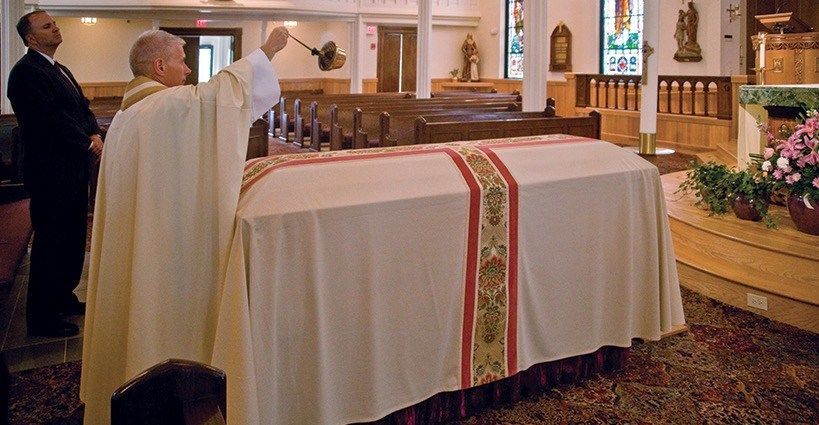
If a loved one has died, please contact the church office to arrange a time to meet to discuss the funeral.
Our Catholic faith teaches that death is not the end but rather the beginning of new life. Death is a time of grief, of hope and of expectations, not only for the immediate family of the deceased, but also for the parish family. The funeral is a time to acknowledge and to respond to a change that has taken place. It is a time for family, friends and relatives to pay their respects to the deceased and give comfort to the family survivors.
The Funeral Liturgy consists of 3 parts:
The Vigil for the Deceased (Wake). Gathering in the presence of the body, the mourners come together either in the home of the deceased, the parish church, or the funeral home to comfort one another with the assurances of faith. It is during the Vigil that words of remembrance are especially appropriate as well as the celebration of the life of the departed.
The Mass of Christian Burial (also called the Mass of Resurrection). The Holy Sacrifice of the Mass is the greatest prayer we can offer on behalf of those we love. Here the Church celebrates the mystery of the passion, death and resurrection of Christ and recognizes the deceased Christian’s participation in that mystery. The symbols used at a funeral mass are the same ones used at the person’s baptism. By this, we recognize their birth into eternal life.
The Burial (Committal). Gathering at the grave site, the people gather for one last time to bless the grave and to commit the mortal remains of the deceased into the ground or a suitable tomb. Here the beloved dead will await their own resurrection when Christ comes in glory.
Funeral arrangements are ordinarily made by the family members who contact the Pastor to conduct the services.
A Word About Cremation
A recent document released from the Holy See in August 2016 stated, “The Church raises no doctrinal objections to the practice of cremation, since cremation of the deceased’s body does not affect his or her soul, nor does it prevent God, in his omnipotence, from raising up the deceased body to new life. Thus cremation, in and of itself, objectively negates neither the Christian doctrine of the soul’s immortality nor that of the resurrection of the body.” This document affirms the permissibility of cremation if it is not done for reasons contrary to the Faith. The current teaching on cremation, therefore, is that body burial is preferred but cremation is permitted. Cremation may be preferred because of “sanity, economic or social considerations.” It should be noted that the Church requires that the cremated remains be buried and not scattered, not should the ashes be worn in a keepsake.
Eucharistic Adoration
What is Eucharistic Adoration
That is a question we often hear from those new to the faith or searching for ways to deepen their relationship with Jesus Christ. Adoration is a way to be present with the Lord and focus on actively listening to His word through prayer.
Eucharistic Adoration
During Eucharistic Adoration, the faithful pray to Jesus Christ, who is present in the Eucharist. The Eucharist, also referred to as the Blessed Sacrament, is typically kept in a tabernacle at your parish church.
While it is true that you can pray to God anywhere and that He is always within you, it is especially powerful to adore Jesus in the Eucharist. In the presence of the Eucharist, we pray to the power and sacrifice that it represents — the body of Jesus, who gave His life so that we may live.
It is His body, blood, soul and divinity that is really, truly, and substantially present in the Eucharist.
We adore and receive the Eucharist in communion at Mass, which is the most beautiful act of worship that we have as Catholics. We have Jesus truly present in all of the tabernacles around the world. We can continue to adore Him in the Eucharist after Mass in a quiet time of prayer and contemplation on Who we have just received. Being in the presence of the body, blood, soul and divinity of Jesus Christ gives spiritual strength and nourishment in a uniquely powerful way.
Where & When:
Friday's after 8:00 am Mass in the Shrine
1st Sunday of the Month at 4:00 pm in St John XXIII